Buying Property with SMSF: All the Pro’s and Con’s

Investing in property through a Self-Managed Super Fund (SMSF) has become an increasingly popular strategy for Australians looking to maximise their retirement savings. This approach offers a range of compelling benefits, from significant tax advantages to enhanced control over investment decisions.
When investing in cash-flow positive properties, such as the ones offered by GPFG, SMSF property investments can yield substantial returns and provide a stable, predictable income stream.
How popular are SMSF property investments?
According to the latest 2023 statistics from the Australian Taxation Office (ATO), there are 606,217 SMSFs in Australia, collectively managing assets worth $889.5 billion. Surprisingly, residential property is only 4.9% of SMSF investment allocation, even though property is a popular investment option for Australians. That number is growing, however, in recent years, as reported by the ATO:
Total SMSF investment in real property reached $166.9 billion in 2020–21, up from $163.0 billion in 2019–20 and $137.0 billion in 2016–17.
Direct investment in non-residential real property increased by 15%, rising from $64.7 billion in 2016–17 to $74.7 billion in 2020–21. In 2019–20, the investment was $73.1 billion.
Residential property investment has grown over the past five years, increasing by 23% from $33.7 billion in 2016–17 to $41.6 billion in 2020–21. The investment in 2019–20 was $39.1 billion.
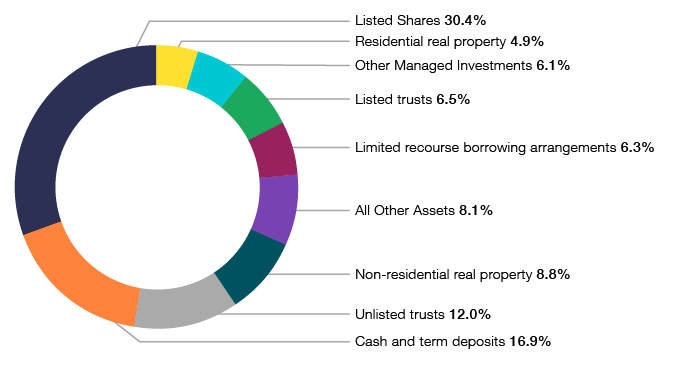
SMSF asset allocation as of 30 June 2021. Source: ATO
“Approximately 30-40% of our investors use the SMSF to purchase units with us,” reports Mark Reed from Geonet. “With our team of financial advisors, we are able to guide investors through how they can use their SMSF to buy cash-flow positive properties, boosting their savings for retirement.”
As Reed mentioned, the SMSF property investments can help to accelerate your savings for retirement, but they also have quite a few other advantages as well. Below are the top benefits of buying an investment property using an SMSF, highlighting how this can be a powerful tool in building a robust and diversified retirement portfolio.
Top 11 Pros of Buying an Investment Property Using SMSF
1. Above average returns and regular cash flow (with the right investment). Purchasing residential and hotel room properties in high-demand locations like Bali can offer substantial rental income due to the constant flow of tourists and expatriates. This regular cash flow can significantly enhance the financial health of your SMSF, providing steady and reliable income. As Reed notes, investing in Bali units can yield above-average returns, often as high as 15-20%, with positive cash flow directly benefiting your SMSF.
Read more: Buy Hotel Room Investment: Why Buying Hotel Rooms is an Emerging Trend in Real Estate Investment
2. Tax Efficiency. Investing through an SMSF allows you to benefit from favourable tax treatment. Earnings within your super fund are taxed at only 15%, which is significantly lower than personal income tax rates. Additionally, if the property is held until the pension phase, the income generated can be entirely tax-free, maximising your retirement savings.
3. Enhanced Purchasing Power. An SMSF can have up to four members, allowing you to pool resources and increase your purchasing power. This combined capital can enable the acquisition of higher-quality or more lucrative properties that might be unattainable individually, thereby opening up superior investment opportunities.
4. Reduced Capital Gains Tax. Holding property within an SMSF can lead to significant capital gains tax (CGT) advantages. For properties held for more than 12 months, the SMSF receives a one-third discount on any capital gains, reducing the CGT liability to a maximum of 10%. If the property is sold during the pension phase, the CGT can be reduced to zero.
5. Direct Control Over Investments. An SMSF is unique in that it allows you to directly own property and have complete control over your investment decisions. You can personally manage your investment strategies, choose specific properties, and ensure proper diversification within your portfolio, aligning your investments with your retirement goals and risk appetite.
“Control is the number one reason for starting an SMSF,” says Reed. “Rather than using an industry fund that is managed by someone else, you are taking the reins and making the decisions, as recommended by your financial advisors.”
For property investment, SMSF trustees have direct control over their investment choices, including the selection of specific properties. This can appeal to those with knowledge of the real estate market or specific investment goals, allowing for tailored investment strategies that align with personal preferences and market insights.
Watch on our podcast: Episode 10 – Exploring Self-Managed Super Funds with Andrew Bonnici
6. Diversification Opportunities. Investing in real estate through an SMSF allows you to diversify beyond traditional assets like shares and bonds. We mentioned the investment allocation above, noting that property is only 4.9% of all SMSF investments, but we are sure to see that number increase in the years to come. When buying property with SMSF, you can potentially reduce overall portfolio risk and benefit from the stability and growth of the real estate market.
7. Stable Income Stream. Rental income from properties, especially in popular tourist destinations like Bali, can provide a consistent and predictable income stream for your SMSF. This stability is particularly beneficial as you approach retirement, offering a reliable source of cash flow to support your lifestyle and financial needs.
8. Long-Term Capital Growth Potential. Real estate, whether in Australia or in the high-demand tourist market of Bali, has historically shown significant long-term appreciation. Investing in property through your SMSF allows you to tap into this growth potential, enhancing your retirement savings and leveraging the tax benefits associated with holding property in a superannuation fund.
However, we do want to mention that foreigners buying into Bali are typically buying a leasehold contract, which can depreciate in value as the lease ends. We recommend that our investors understand and negotiate their extension clauses well before this time.
What does appreciate in Bali, however, is the overnight and rental rates as Bali becomes more popular. Recent data from Colliers showed a forecasted increase of 6% in hotel occupancy for 2024, and an 3.4% increase in Average Daily Rate across the island.
9. Asset Protection. Assets within an SMSF are generally protected from creditors in the event of bankruptcy, offering a layer of security not typically available through personal investment vehicles. This protection ensures that your retirement savings are safeguarded even in adverse financial situations.
10. Leverage Opportunities. Through Limited Recourse Borrowing Arrangements (LRBAs), SMSFs can borrow to purchase property, enabling the fund to acquire assets that might otherwise be out of reach, without exposing other fund assets to risk. This leverage can enhance investment returns while managing risk.
11. Estate Planning Benefits. SMSF property investments can be structured as part of an estate plan, potentially providing tax-effective wealth transfer to beneficiaries. This can ensure that your assets are passed on in a manner that adheres to the fund’s trust deed and superannuation laws, while also offering potential tax benefits.
Cons of Buying an Investment Property Using a Self-Managed Super Fund (SMSF)
Of course, as with any investments and opportunities, we must also discuss the cons. Buying an investment property with SMSF might not be forever, so please discuss with a qualified finance advisor, who can assess your financial situation and investment goals.
1. Cannot Leverage Personal Benefits. Investments with SMSF must comply, with no exceptions, to the “Sole Purpose Test,” which requires that these investments are only for retirement savings, not personal use or any other reasons.
Transactions through an SMSF must be conducted at arm’s length, meaning you cannot purchase from, sell to, or rent to a related party. For example, you cannot buy a property through your SMSF for your children or other relatives to live in, limiting the personal benefits you might otherwise gain from property ownership.
2. Cash Flow Deficiencies. While SMSFs can borrow capital to purchase property, they cannot borrow to build or improve the property. Any capital used for improvements must come from existing superannuation savings. Therefore, investors need to ensure their contributions and the SMSF’s cash levels are sufficient to cover ongoing costs and unexpected expenses.
“Thankfully, our investors don’t necessarily need to worry about ongoing expenses because management fees, sinking funds and insurances are already taken into account in the contract,” says Reed. “So there should be no surprises that require additional cash flow.”
3. Complexity. Investing in property through an SMSF can be highly complex, with strict rules and regulations to follow. Mistakes can result in severe penalties. Seeking professional advice is crucial to navigating these complexities and ensuring compliance with all legal requirements.
4. Setup and Ongoing Costs for Audits & Appraisals. Property investments within an SMSF, especially those involving Limited Recourse Borrowing Arrangements (LRBAs), can incur higher setup fees compared to properties bought with cash. Additionally, SMSFs must undergo an annual tax return and audit by a qualified tax agent, adding to the ongoing costs that need to be carefully considered.
5. Liquidity Issues. Real estate is an illiquid asset, meaning it cannot be quickly sold or converted to cash. In times of financial need or market downturns, this lack of liquidity can pose significant challenges for an SMSF, particularly if the fund needs to meet its obligations or pay out benefits.
6. Regulatory Changes. The rules and regulations governing SMSFs and property investments can change, potentially affecting the viability and benefits of holding property in an SMSF. Keeping up with these changes and ensuring compliance can be burdensome and may require ongoing professional advice.
7. Potential for Over-Commitment. Borrowing to invest in property within an SMSF can lead to over-commitment, where the fund’s resources are stretched thin. If rental income or property values do not meet expectations, the SMSF might struggle to meet loan repayments, leading to financial stress and potential breaches of superannuation laws.
“With control, comes responsibility, right?” says Mark. “Having control of your retirement and super is the best benefit of having an SMSF. However, with that, you have to be responsible to fully understand the costs and returns, audit ramifications, and any changes to regulations. Only you and your financial advisor can be sure if an investment of any kind is right for you and your goals.”
Read more: Australian Property Investors are ‘Copping It’
Buying Property with SMSF with GPFG
As mentioned above, approximately 30-40% of our investors use SMSF to invest with us. The returns on our investments, particularly the regular passive income, are often better than what they are receiving in their industry super funds. Many have their SMSFs already set up, but if they don’t, our team can help with the process to establish your SMSF. Use our pros and cons above as a guide, but do seek professional advice to make sure any investment aligns with their financial goals and risk tolerance.
For more information, talk to our team today.
If you like this guide, you may also like:
- SMSF Property: How to Maximise Your Retirement Savings with SMSF Property Investments
- Self Managed Super Fund Property: Our Full FAQ’s Guide
- Buy Property With Super: 20 Things To Consider When Investing with SMSF