From Bulgari resorts to Armani hotels, some of the world's most recognisable brands are creating experiences that go far beyond their traditional businesses. What's behind the growing relationship between global lifestyle brands and hospitality?
There was a time when the relationship between fashion and hotels was largely confined to designer boutiques in luxury hotel lobbies. Today, you can check into an Armani hotel, spend your holiday at a Bulgari resort or enjoy a weekend at one of LVMH's Cheval Blanc properties. The world's biggest fashion and lifestyle brands want to be part of where people travel, stay and spend their time.
A shop, an advertisement or a social media campaign reaches someone for a moment. A beautifully designed hotel keeps them for several days, surrounded by the brand's design, atmosphere, restaurants, wellness and hospitality, and that relationship becomes far more personal than a purchase.
Bulgari Hotels & Resorts opened its first property in Milan in 2004, followed by Bali in 2006, and today has hotels and resorts in major destinations around the world.
Armani took a different approach, opening the Armani Hotel Dubai inside the Burj Khalifa in 2010, with interiors, furnishings and an atmosphere that reflect Giorgio Armani's own design philosophy. Then there's Cheval Blanc, LVMH's own hotel collection, which takes the group's craftsmanship and service to Paris, Courchevel and St-Tropez.
In each case, the brand's identity shapes how the property looks, feels and operates. Hospitality also takes a brand into new markets. A guest might discover it for the first time through a hotel stay, a restaurant or a beach club, without ever having bought its products.
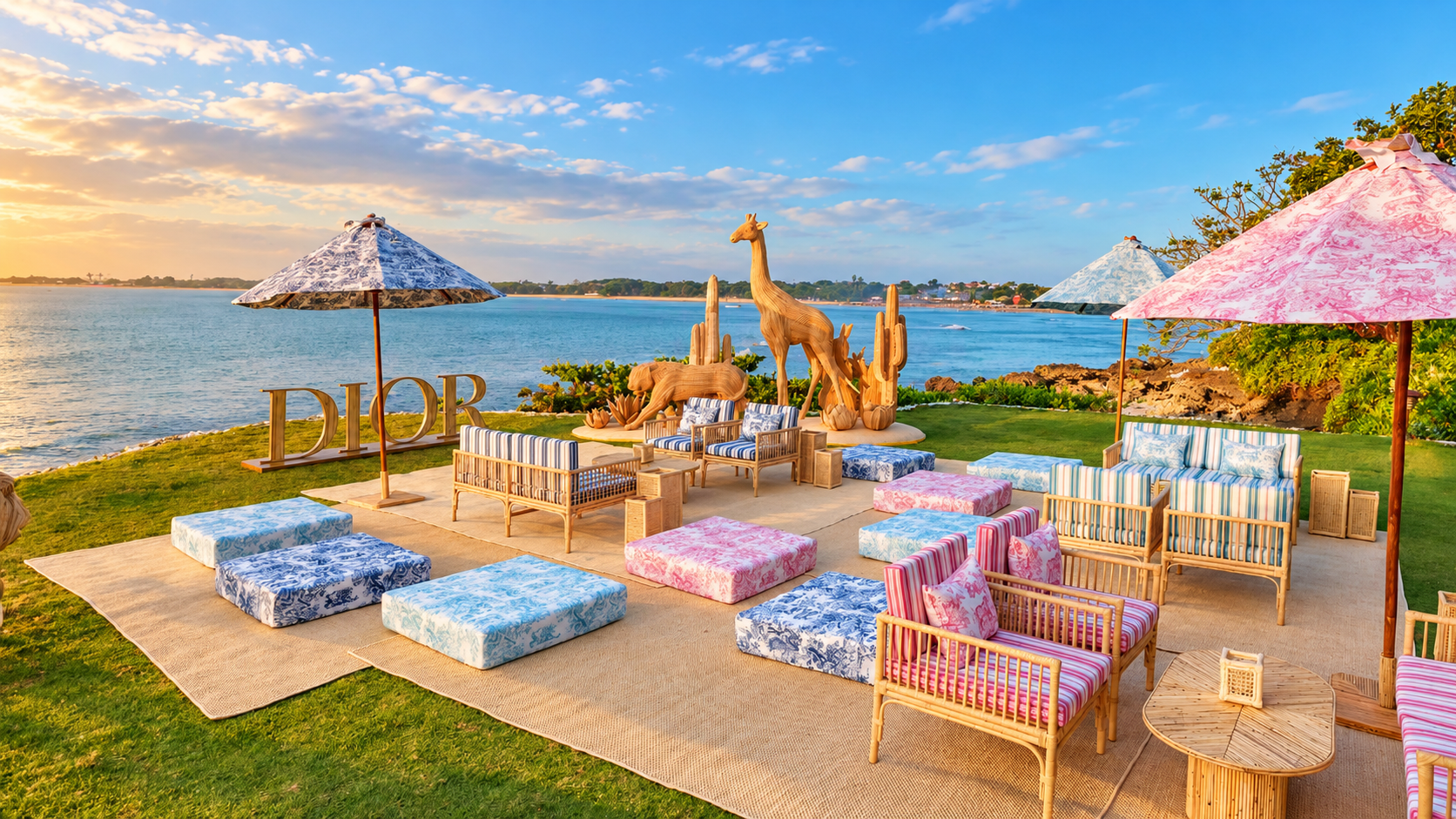
Fashion houses are also taking over existing hotels, one season at a time. Dior has spent three summers at Four Seasons Resort Bali at Jimbaran Bay with its Dioriviera pop-up, most recently in 2025, when it dressed the Sundara beach club in Toile de Jouy and added a boutique, a Dior Café and private sunset picnics on the beach. Missoni turned the beachfront at The Ritz-Carlton, Bali into the Missoni Resort Club in late 2024, with its zigzag pattern across the loungers, parasols and cabanas, and has taken the same idea to One&Only Reethi Rah in the Maldives and Cali Mykonos in Greece.
In Europe this year, Burberry dressed Hôtel Belles Rives on the French Riviera and One&Only Aesthesis near Athens in its house check, Gucci took over the La Rose des Vents beach club in Monte Carlo, and Jacquemus gave the beach club at Mandarin Oriental, Bodrum his signature stripes. For a few months, the loungers, towels, menus and a pop-up boutique all carry the house's look, and hotel guests spend their holiday inside the brand's world.
The commercial arrangements vary. The brand isn't necessarily the owner or the operator, and successful projects often bring together the brand, an experienced developer and a specialist hospitality operator.
According to Knight Frank's The Residence Report 2026/27, the number of branded residence developments worldwide has almost tripled in a decade, from 354 in 2015 to 903 by the end of 2025, and the pipeline points to nearly 1,800 schemes by 2031.
Hotel groups such as Marriott, Four Seasons, Accor and Hilton have traditionally led the market, and fashion, automotive and lifestyle brands are now gaining ground. Knight Frank forecasts that non-hotel brands will account for almost 40% of branded residence schemes by 2028, up from around 30% in 2025. Fashion houses including Armani, Missoni and Elie Saab are among the names with residential projects, alongside car brands such as Aston Martin and Pininfarina.
A recognised name helps a property get noticed, and an established brand comes with an identity people already understand. Its customers may have followed it for years, bought its products or read its publications, and that familiarity gives a new hotel an immediate connection with them.
A brand also gives a clear creative direction. Architecture, interiors, dining, wellness, music and the public spaces can all be built around one identity, giving a property its own character in a market where many luxury hotels compete on similar facilities and finishes.
A famous name still doesn't guarantee a successful hotel. Guests expect excellent service, memorable dining and an experience that justifies the price, and the hotel needs the right location and an experienced team. The brand sets the identity, the developer brings the concept to life, and the operator delivers the hospitality day after day.
Knight Frank's report also shows where brands are heading. In 2016, just 38% of branded residence developments were outside major cities. By 2025 that had reached 55%. Phuket is a striking example: counting projects in development, the island now has 35 branded residence schemes, more than London's 30.
Resort destinations give hospitality brands room for a much broader experience. Beach clubs, restaurants, wellness, cultural programming and outdoor spaces can become central features of the property.
In January, Tripadvisor named Bali the No. 1 destination in the world in its 2026 Travelers' Choice Awards, ahead of London, Dubai and Paris. In July, Travel + Leisure readers voted 10 Bali hotels into the World's Top 100 Hotels for 2026, more than any other destination.
The island's reputation rests on design, wellness, dining, beach culture and hospitality. Travellers arrive with plans well beyond their room, so a hotel here can become a destination in its own right, drawing local visitors as well as staying guests. Bulgari Resort Bali, open since 2006, has shown that a global luxury brand can build a lasting presence on the island.
International brands in Bali need to bring something of their own while staying connected to the island, and a property that could be anywhere in the world misses much of what draws people to Bali in the first place.
ELLE has spent 80 years as one of the world's best-known fashion and lifestyle brands, and in the last few years it has moved into hospitality and real estate in a big way. Maison ELLE boutique hotels are open in Paris and Amsterdam. ELLE-branded residences have launched in Miami and Dubai, and São Paulo is now home to the brand's first residential projects in Latin America. Beyond hotels and homes, ELLE Cafés serve guests in Istanbul, Phuket and Pattaya, and ELLE spas and salons welcome clients in Tokyo, Shanghai, Guangzhou and Hyderabad.
We looked at this expansion in more detail in ELLE: From Global Media Powerhouse to Hospitality and Real Estate.
For Geonet, this momentum sits at the heart of ELLE Resort & Beach Club in Seminyak, the first ELLE resort anywhere in the world. ELLE's identity is built around fashion, beauty, culture, design and contemporary lifestyle, with a global audience that has followed the brand for generations. The resort carries that lifestyle into hospitality, through the interiors, dining, wellness and beachfront.
For Geonet CEO Chad Egan, the appeal lies in the depth of the brand's identity.
"When we looked at ELLE, we saw a brand with a real identity beyond fashion. It has a connection with design, culture, travel and the way people want to experience life. For us, that creates an opportunity to develop a resort that reflects the brand in everything from the design to the experiences guests enjoy."
The relationship between global lifestyle brands and hospitality continues to expand, with fashion houses and other internationally recognised names finding new ways to connect with people through places and experiences.
Travellers are also becoming more discerning. A beautiful interior and a famous name may win the first booking. Service, atmosphere, food and location decide whether guests come back.
Developers who bring together a brand with real cultural relevance, a location that suits it and a team that can deliver will stand out. Travellers get more hotels and resorts with personalities of their own.
The brands that succeed in hospitality will be those that give people a reason to return long after the novelty of the name has worn off.
Talk to our team about ELLE Resort & Beach Club and how we're bringing one of the world’s top lifestyle brands to the shores of Bali.